
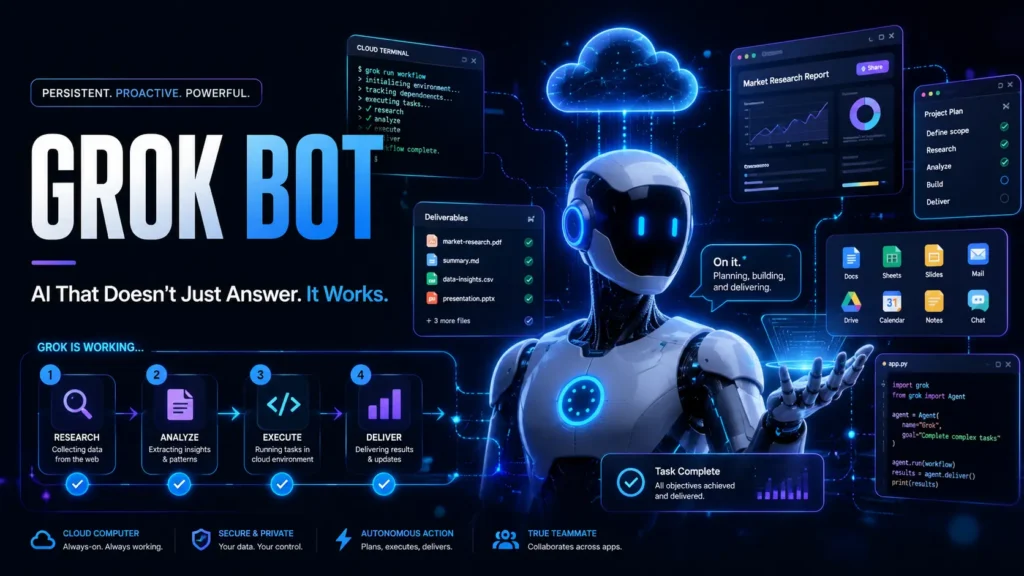
Grok is moving beyond answering questions. Its newest feature, Grok Bot, is designed to act more like a persistent digital employee—using a computer, working across applications, remembering how you work and completing multi-step tasks on your behalf.
Grok’s developer officially introduced Grok Bot on August 11, 2026, describing the early-beta product as a team of “always-on” AI agents capable of carrying out real work rather than simply generating instructions or drafts.
That distinction could make Grok Bot one of the more significant developments in the rapidly evolving AI-agent market.
What Is Grok Bot?
Grok Bot allows users to create named, persistent AI teammates, with each Bot assigned a role or responsibility.
Unlike a conventional AI conversation that mainly responds inside a chat window, Grok Bots operate through a persistent cloud computer equipped with a browser, filesystem and terminal. They can use supported connectors as well as interact with websites and applications through their computer interface.
In practical terms, you could create Bots such as:
- Sales Bot — researches prospects, prepares CRM updates and drafts follow-ups.
- Marketing Bot — researches trends, prepares campaign material and coordinates recurring marketing work.
- Operations Bot — processes routine administrative work and prepares reports.
- Recruitment Bot — researches candidates and prepares outreach.
- Development Bot — investigates bugs, works with code and coordinates development tasks.
- Research Bot — continuously gathers and organizes information around an assigned subject.
The key difference is persistence: instead of starting from scratch every time, a Bot can retain its role, preferences and relevant context over time.
Grok Bot Gets Its Own Computer
Perhaps the most interesting part of Grok Bot is that the AI is not limited to generating text telling you what to do.
It can actually use a computer.
Every Grok Bot account receives a persistent cloud environment through which Bots can access a browser, files, command-line tools and authenticated web applications. Because the work happens in the cloud, tasks can continue even after the user closes the Grok Bot application or shuts down their laptop.
This changes the interaction from:
“Tell me how to perform this task.”
to:
“Perform this task and come back when you need my approval.”
That is a major shift in how personal and business AI may increasingly be used.
You Talk to a Bot Like a Team Member
Grok Bot deliberately avoids requiring users to construct complicated automation workflows before getting started.
A user creates a Bot, gives it a name, defines its primary responsibility and describes how it should behave. Tasks can then be assigned through normal conversational messages.
For example:
Name: Reliancy Marketing Bot
Role: Digital Marketing Assistant
Responsibility: Research technology developments, identify relevant stories, prepare SEO-ready articles, draft social media posts and present everything for approval before publication.
From there, additional instructions and preferences can gradually make the Bot more specialized.
The result is closer to managing an AI colleague than repeatedly prompting a generic chatbot.
Multiple Grok Bots Can Work Together
Grok Bot becomes even more interesting when several agents are used together.
Bots can communicate with one another, share context and pass work between themselves. Grok also supports group conversations where multiple Bots can collaborate on a project without forcing the human user to manually transfer information from one agent to another.
Imagine a digital business team consisting of:
Research Bot → Content Bot → SEO Bot → Social Media Bot
The Research Bot discovers an important technology development.
It hands the information to the Content Bot.
The Content Bot prepares an article.
The SEO Bot optimizes the headline, metadata and search structure.
The Social Media Bot prepares promotional posts.
A human can remain responsible for the final judgment and approval.
That model gives us a glimpse of what increasingly agentic workplaces may look like.
Grok Bots Can Learn Routines
Grok Bot also supports reusable routines.
A user can demonstrate or define a recurring workflow and allow the Bot to perform that process again later, either manually or according to a routine. The system provides controls for enabling, pausing, editing, testing and reviewing those routines.
This opens possibilities such as:
- preparing a morning business intelligence briefing;
- researching new potential customers;
- checking specified sources for industry developments;
- preparing recurring reports;
- organizing incoming business information;
- reviewing operational data;
- preparing drafts for human approval.
Rather than treating every interaction as an isolated prompt, AI begins to become part of an organization’s operating process.
Human Approval Still Matters
Giving an AI access to real applications, authenticated accounts and business systems creates obvious security considerations.
Grok Bot therefore includes approval mechanisms intended to keep consequential actions under human control. Users can establish boundaries requiring approval before actions such as sending information, publishing content, making purchases, deleting material or modifying production systems.
This is particularly important because all Bots belonging to a user operate on the same account-level cloud computer. Browser sessions, files and credentials placed on that environment may therefore be accessible across that user’s Bots rather than being isolated separately for every Bot.
Businesses adopting agentic AI will consequently need to think seriously about permissions, data access, approval policies and cybersecurity rather than treating AI agents like ordinary chatbots.
Who Can Use Grok Bot?
Grok Bot remains an evolving beta product.
Official documentation currently lists eligible access through plans including SuperGrok Heavy, Cursor Ultra and qualifying Cursor team subscriptions, with desktop support for Windows and macOS as well as an iPhone application. Availability and enterprise access are continuing to evolve during the rollout.
The iPhone application connects to the same Bots, conversations, routines and cloud computer used by the desktop experience, allowing users to assign work, review results and approve actions away from their main computer.
Why Grok Bot Matters
The importance of Grok Bot is not simply another new AI feature.
It demonstrates the broader transition taking place across artificial intelligence:
Chatbots → Assistants → Agents → AI Teammates
Traditional generative AI waits for a prompt and produces an answer.
Agentic AI receives an objective, determines the steps required, interacts with tools and attempts to complete the objective.
Persistent AI teammates go another step by maintaining roles, workflows, files, preferences and ongoing responsibilities.
Grok Bot is clearly designed around that latter vision.
What This Could Mean for Businesses in Kenya
For businesses in Kenya and across Africa, AI agents could become particularly valuable where organizations need to increase productivity without proportionally increasing repetitive administrative workload.
Potential applications include customer research, sales preparation, digital marketing, website management, reporting, business intelligence, software development and administrative support.
However, organizations should adopt these technologies carefully.
The strongest approach is unlikely to be handing unrestricted control to an AI agent. Instead, businesses can automate research, preparation and repetitive execution while retaining human approval for financial transactions, customer communications, publication, security changes and other consequential decisions.
Used correctly, AI agents can augment employees rather than simply replace individual tasks.
From AI That Answers to AI That Acts
For several years, the defining interaction with generative AI has been a text box.
You ask.
AI answers.
Grok Bot represents something different.
You assign.
The AI works.
You supervise.
That may ultimately prove more important than improvements in chatbot intelligence alone.
As Grok Bot and competing autonomous-agent technologies mature, businesses may increasingly maintain their own collections of specialized AI teammates responsible for research, marketing, development, administration and operations.
The next phase of artificial intelligence is therefore becoming less about what an AI knows and increasingly about what an AI can reliably accomplish.
And Grok Bot is an early indication of how quickly that future is arriving.