
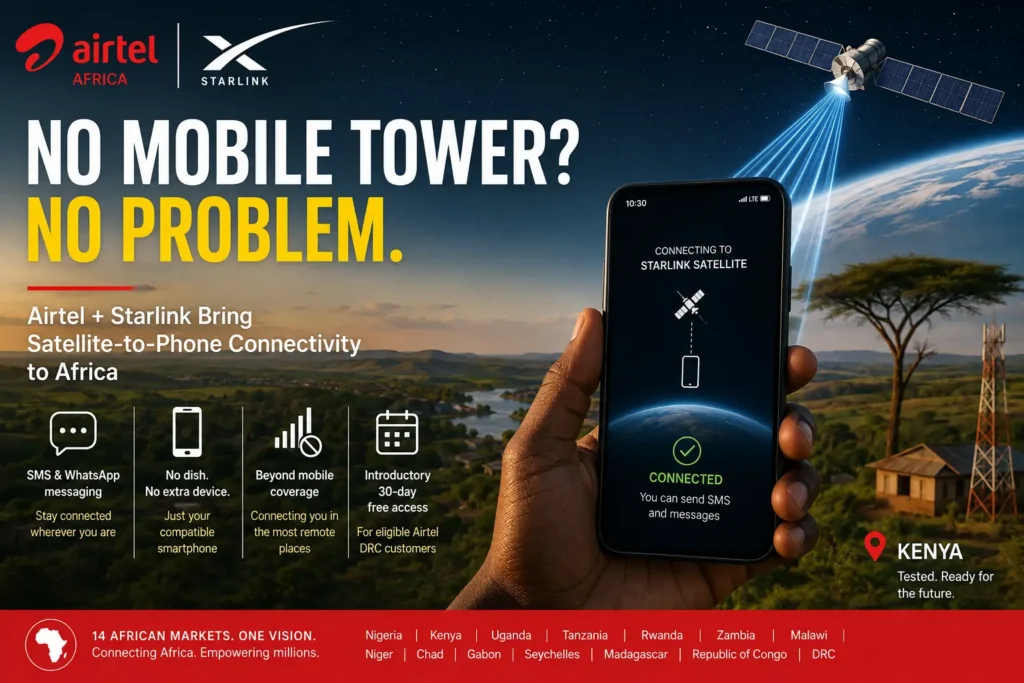
Airtel Africa and SpaceX’s Starlink have taken a major step toward eliminating mobile network dead zones across Africa with the commercial launch of direct satellite-to-phone connectivity in the Democratic Republic of Congo (DRC).
The service, commercially launched on 14 August 2026, allows compatible smartphones to communicate directly with Starlink satellites when conventional Airtel mobile coverage is unavailable.
The development is particularly significant for Kenya. Airtel and Starlink have already tested the technology in Kenya, and the country is among the 14 African markets targeted for rollout once the necessary regulatory and spectrum approvals are secured.
A Mobile Network Tower — in Space
Traditional satellite internet services generally require users to purchase and install specialised equipment such as a satellite dish or terminal.
Starlink’s direct-to-cell technology changes that model.
Instead of requiring a Starlink dish, compatible smartphones communicate directly with satellites equipped with cellular technology. In effect, the satellites function as mobile network towers in space.
When an Airtel subscriber travels beyond the reach of terrestrial mobile towers, a compatible phone can potentially connect to the satellite network rather than simply displaying “No Service.”
For Africa, where enormous areas remain difficult or uneconomical to cover with conventional towers, this could become an important extension of existing telecommunications infrastructure.
What Can You Actually Do With It?
The initial DRC service should not be confused with the high-speed Starlink broadband connection provided through a Starlink terminal.
At launch, satellite-to-phone connectivity is considerably more limited.
The service initially supports:
- SMS messaging
- Selected light-data applications
- WhatsApp messaging
- Basic connectivity in locations without terrestrial Airtel coverage
It does not initially provide the unrestricted broadband experience users would expect from 4G, 5G or conventional Starlink internet.
High-bandwidth activities such as HD video streaming, large downloads and other data-intensive applications remain outside the initial service.
But the significance lies elsewhere: a normal smartphone can remain connected where there is no conventional mobile tower.
No Starlink Dish Required
Perhaps the most interesting aspect for ordinary consumers is what they do not need.
Users don’t have to carry a Starlink Mini, install a satellite dish on a building or position a separate terminal whenever they need connectivity.
The DRC implementation initially works with eligible LTE Android smartphones, while support for Apple devices is expected later.
Eligible Airtel DRC subscribers can register through the MyAirtel application. The introductory service includes a 30-day free-access period, after which connectivity is expected to form part of eligible Airtel data offerings.
Long-term pricing will be one of the important factors determining how widely the technology is adopted.
Why This Matters for Africa
Africa presents an unusually compelling use case for direct-to-cell satellite communications.
Building mobile towers across every sparsely populated, mountainous, forested or otherwise difficult-to-access region can be prohibitively expensive.
The DRC illustrates the challenge particularly well.
Its enormous land area, dense forests, dispersed communities, difficult terrain and security challenges have contributed to substantial connectivity gaps.
Satellite-to-phone technology doesn’t eliminate the need for terrestrial infrastructure. Instead, it provides another coverage layer capable of reaching places where building conventional infrastructure is difficult.
That distinction matters.
Rather than replacing mobile networks, satellite connectivity could increasingly fill the gaps between them.
Kenya Could Be One of the Most Interesting Markets
For Kenya, the potential applications extend far beyond ordinary consumer messaging.
Airtel and Starlink successfully tested direct-to-cell data and messaging capabilities in Kenya in March 2026, including locations where Airtel’s terrestrial network was unavailable.
A commercial Kenyan rollout would therefore represent a progression from technology already demonstrated locally.
Potential beneficiaries could include people travelling or working in remote areas such as pastoral regions, farms, conservancies, construction sites and isolated settlements.
The technology could also prove useful across sectors including:
Agriculture: Farmers and agricultural field teams operating far from reliable mobile infrastructure could maintain basic communications.
Transport and logistics: Long-distance drivers and logistics operators could potentially remain reachable along poorly covered routes.
Tourism and conservation: Safari operators, conservancies, researchers and travellers frequently operate beyond dependable cellular coverage.
Emergency response: Satellite connectivity could provide an alternative communication layer when terrestrial infrastructure is damaged or unavailable.
Healthcare: Remote clinics and travelling health workers could gain an additional means of maintaining essential communications.
Energy and infrastructure: Engineers working on power, water, road and telecommunications projects could remain connected in remote deployment areas.
It Could Change What “Network Coverage” Means
Mobile coverage has traditionally been an infrastructure problem.
A telecommunications operator identifies an area, obtains spectrum, constructs towers, installs radio equipment, connects those towers to its wider network and maintains the infrastructure.
Satellite-to-cell technology introduces another possibility.
A mobile operator can combine its terrestrial infrastructure with a constellation of satellites moving overhead.
That creates the possibility of a future network in which your phone dynamically moves between terrestrial and satellite coverage depending on availability.
In cities such as Nairobi, Mombasa or Kisumu, terrestrial 4G and 5G networks would continue handling most communications.
Drive into an area beyond tower coverage, however, and a satellite connection could provide a basic communications fallback.
For consumers, the technological complexity could eventually become almost invisible.
Starlink and Airtel Are Building a Much Bigger African Network
The DRC launch isn’t intended to remain an isolated project.
Airtel Africa and SpaceX announced their direct-to-cell partnership in December 2025, with plans to introduce the technology across Airtel Africa’s operations.
The targeted markets include:
Kenya, Uganda, Tanzania, Rwanda, Nigeria, Zambia, Malawi, Niger, Chad, Gabon, Seychelles, Madagascar, the Republic of Congo and the Democratic Republic of Congo.
The DRC has become the first of these markets to move into commercial operation.
However, satellite capability alone doesn’t mean Starlink and Airtel can simply activate the service everywhere.
Each country has its own telecommunications laws, spectrum policies and licensing requirements.
Commercial launches therefore remain dependent on approval from national regulators.
In Kenya, that makes the regulatory framework surrounding satellite direct-to-device communications an important part of what happens next.
Competition in African Satellite Connectivity Is Heating Up
Starlink is not operating in isolation.
Telecommunications operators and satellite companies increasingly see low-Earth-orbit satellite networks as a practical way of expanding connectivity.
Vodacom has also pursued cooperation with Starlink in African markets, while Amazon is developing its competing satellite broadband constellation.
This could create an interesting new competitive layer in African telecommunications.
The future battle may no longer be simply:
Airtel vs Safaricom vs MTN vs Vodacom.
It could increasingly involve combinations such as:
Mobile operator + satellite constellation + terrestrial 4G/5G infrastructure.
That could fundamentally alter how operators measure and advertise coverage.
What About Safaricom?
For Kenya, the strategic question will inevitably extend to Safaricom.
If Airtel commercially introduces direct-to-cell Starlink connectivity in Kenya, the competitive advantage would not necessarily be faster internet in Nairobi.
It would be coverage beyond the traditional network footprint.
That could become particularly attractive to customers who frequently travel, farm, work or conduct business outside major population centres.
It may also encourage competing operators to accelerate their own satellite partnerships or alternative non-terrestrial network strategies.
The result could ultimately benefit consumers through wider coverage, improved resilience and greater competition.
Satellite Connectivity Could Become a Standard Smartphone Feature
Direct-to-device satellite communication is part of a broader change already occurring in the smartphone industry.
The boundary between a “satellite phone” and an ordinary smartphone is beginning to disappear.
Historically, satellite phones were specialised and expensive devices primarily associated with governments, shipping companies, expeditions, militaries and emergency organisations.
The emerging model is different.
Consumers continue using ordinary smartphones while satellite connectivity becomes another network option built into the telecommunications ecosystem.
As satellite capacity and handset compatibility improve, services are expected to progress beyond basic messaging toward richer data connectivity.
That is when the technology could become genuinely transformative.
Challenges Remain
The technology is promising, but several practical issues will determine its impact.
Device compatibility remains important. Not every smartphone will immediately support direct satellite communication.
Pricing could determine whether satellite connectivity becomes a mass-market service or primarily an emergency and professional communications product.
Regulatory approval and spectrum allocation will affect how quickly operators can introduce the service in individual African countries.
Satellite capacity will also matter as millions of users potentially begin sharing direct-to-cell infrastructure.
And although satellites can dramatically extend geographical coverage, terrestrial mobile towers remain far more suitable for serving dense populations and handling large volumes of high-speed data.
The two technologies are therefore more likely to complement each other than compete directly.
A Significant Moment for African Connectivity
The DRC commercial launch is important because direct-to-phone satellite communication has moved from demonstrations and promises into a service available to actual African mobile customers.
For countries with substantial rural and remote populations, that could be the beginning of a profound change.
The question may gradually shift from:
“Is there a mobile tower nearby?”
to:
“Can my phone see the sky?”
For Kenya, the development is especially worth watching because testing has already taken place locally and Airtel has included the country in its planned African rollout.
If regulatory approvals follow, ordinary Kenyan smartphones could eventually remain connected in places where mobile coverage traditionally disappears — without requiring a Starlink dish.
That would not simply be another upgrade from 4G to 5G.
It would represent a fundamental expansion of what a mobile network can be.