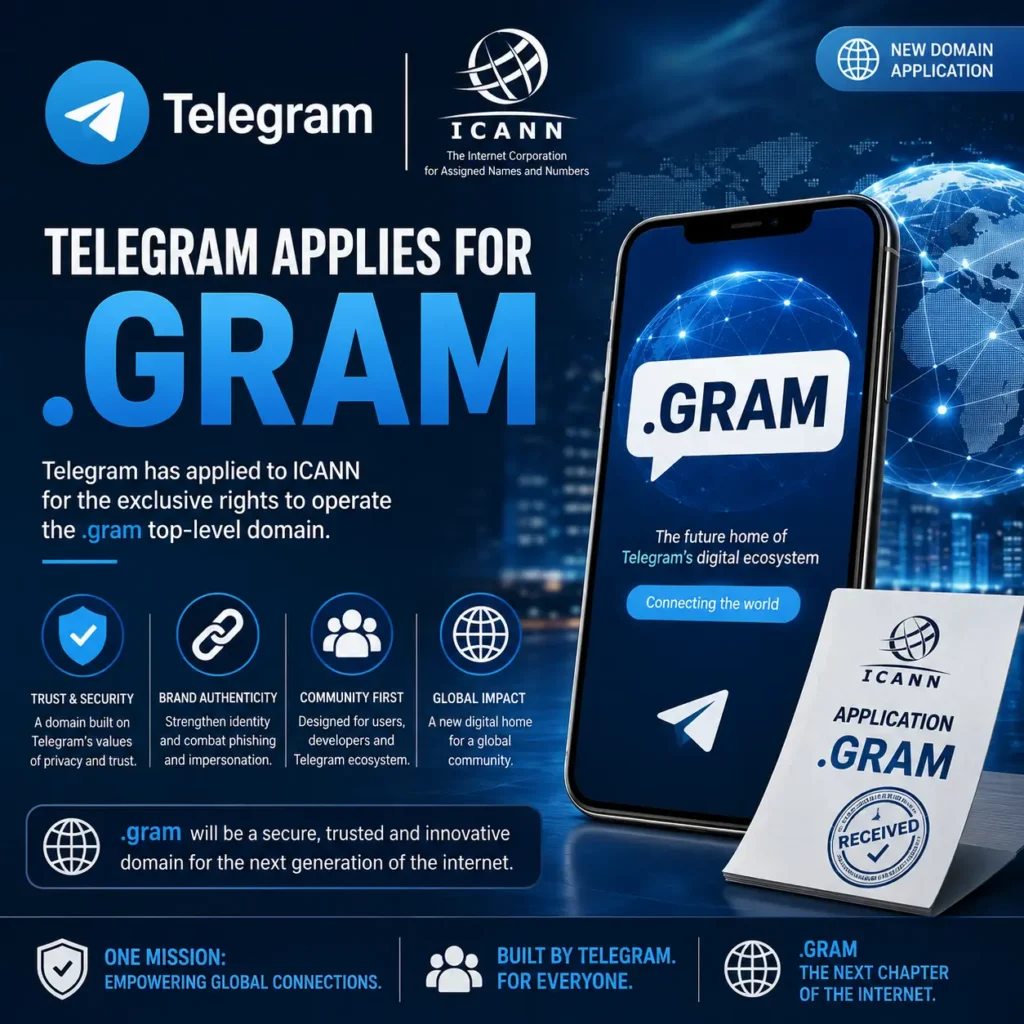
Telegram has applied for the .gram top-level domain in ICANN’s 2026 expansion round, potentially opening the door for Telegram users to turn their usernames into real internet addresses such as durov.gram. If approved, the move could push Telegram far beyond messaging and deeper into web publishing, digital identity, business websites and AI-generated online experiences.
Telegram founder Pavel Durov disclosed the application on August 18, 2026, saying that if ICANN approves .gram, Telegram’s roughly one billion users could potentially receive second-level domain names corresponding to their usernames and use them to create interactive websites, including sites generated from prompts.
The announcement arrives at an unusually important moment for the global Domain Name System.
ICANN closed the application window for its 2026 New Generic Top-Level Domain Program on August 12 after receiving more than 1,600 applications. The organization is now carrying out administrative checks before formally publishing the applied-for strings on “Reveal Day,” which ICANN expects no later than nine weeks after the application window closed.
That means one point needs to be made clear:
.gram has not yet been approved or delegated. Telegram has applied for it.
If Telegram successfully passes ICANN’s evaluation process, resolves any objections or competing applications, completes contracting and ultimately receives delegation of .gram into the global DNS root, the result could be one of the most interesting integrations yet between a social platform and the traditional internet domain system.
What Exactly Is .gram?
Today, most Telegram public identities are expressed through handles such as:
@username
and links such as:
t.me/username
With a .gram top-level domain, the model could become:
username.gram
That distinction is significant.
A .gram address would not merely be another page beneath Telegram’s existing website. If implemented as conventional second-level domain registrations, it would exist directly beneath the .gram top-level domain in the global Domain Name System.
In practical terms, a Telegram creator called kenyatech, for example, could potentially have:
kenyatech.gram
A business could potentially use:
reliancy.gram
A public figure might use:
name.gram
Telegram has not yet published detailed registration rules, pricing, eligibility requirements or technical architecture for such domains, so it remains too early to assume every username will automatically receive a free domain. Durov’s announcement nevertheless makes clear that Telegram sees .gram as a potential identity layer for its enormous user base.
This Is More Than a New Domain Extension
The strategic importance of .gram is not the four letters themselves.
It is what Telegram could build on top of them.
Telegram already combines messaging, channels, communities, bots, mini apps, payments and content distribution. A globally recognized domain namespace could connect those services directly to the open web.
Instead of a Telegram identity ending inside an app, the same identity could potentially become a website.
That creates a bridge between:
Telegram username → domain name → website → business identity → AI-generated web presence
For hundreds of millions of users who have never bought hosting, configured DNS or built a conventional website, that could dramatically lower the barrier to owning a recognizable web address.
1. Telegram Usernames Could Become Internet Identities
One of .gram’s biggest potential advantages is identity continuity.
People already spend considerable effort acquiring memorable Telegram usernames. Under the proposed concept, that identity could extend outside Telegram itself.
Instead of sharing several different addresses—
a Telegram handle, social-media profile, portfolio page and website—
a user could potentially establish a recognizable .gram domain connected to the same identity.
For creators, businesses and public personalities, this could turn Telegram usernames into more valuable digital assets.
It would also make domains easier to remember:
@reliancy → reliancy.gram
@photographer → photographer.gram
@shopname → shopname.gram
That simplicity could make the domain system feel much more accessible to users who currently find domain registration and hosting unnecessarily technical.
2. AI Could Make Website Creation Almost Instant
Durov’s announcement becomes particularly interesting because he linked .gram domains with the ability to create interactive websites through prompts.
Imagine typing:
Create a website for my Nairobi photography business with my Telegram contact, portfolio, prices and booking button.
An AI system could theoretically generate the website and publish it at:
myphotography.gram
That would compress several traditional web-development steps into a single workflow.
Normally, a new website may involve:
domain registration → hosting → DNS → design → development → content → deployment
Telegram could potentially turn that into:
choose identity → describe website → publish
This is where .gram could become much more disruptive than a normal branded domain extension.
3. Small Businesses Could Get Online Faster
The implications could be particularly meaningful in markets such as Kenya and the wider African digital economy.
Millions of entrepreneurs already conduct business through messaging platforms without maintaining a conventional website.
A trader may sell through Telegram, WhatsApp, Instagram or Facebook while relying entirely on social profiles.
If Telegram eventually allows a business to convert its username into a .gram site with little technical knowledge, the merchant could gain a web presence without first understanding hosting control panels, DNS records or content-management systems.
A .gram website might eventually provide a home for:
- product catalogues;
- business descriptions;
- contact information;
- Telegram chat links;
- booking forms;
- portfolios;
- payment integrations;
- community channels;
- Mini Apps;
- AI assistants.
The precise features remain speculative until Telegram publishes its implementation plans, but the domain application creates the technical possibility for Telegram to connect its platform identities to globally resolvable web addresses.
4. Telegram Could Reduce Its Dependence on Another Registry
The timing of the .gram announcement also deserves attention.
Telegram currently relies heavily on t.me, a domain under Montenegro’s .me country-code top-level domain.
On July 13, 2026, t.me temporarily stopped resolving after the domain received a registry-level serverHold. The service returned the following day, with the .me registry saying the hold had been related to OFAC compliance. The disruption temporarily broke Telegram short links around the world.
A Telegram-operated .gram registry would create a fundamentally different arrangement.
Instead of being only a registrant beneath somebody else’s top-level domain, a successful .gram applicant would become the registry operator for an entire TLD, subject to its Registry Agreement and ICANN requirements.
That would give Telegram far greater operational control over its namespace.
It would not make Telegram immune from regulation, ICANN contractual requirements or DNS-abuse obligations. But strategically, it could reduce dependence on a third-party country-code domain for one of Telegram’s most important identity systems.
5. .gram Could Become a Massive Creator Economy
There is also a commercial opportunity.
A billion-user platform introducing its own domain namespace immediately creates potential demand for valuable names.
Short words, personal names, professions, locations and brands could become desirable addresses.
Examples might include:
travel.gram
music.gram
nairobi.gram
fashion.gram
news.gram
shop.gram
How Telegram handles allocation will therefore matter enormously.
It could reserve names, prioritize existing Telegram usernames, auction premium domains, charge annual registration fees or combine several models.
Telegram has not yet announced those policies.
But if .gram succeeds, domain ownership could become another layer of Telegram’s emerging digital economy.
6. Businesses Could Connect Websites Directly to Telegram Services
A .gram domain could also make Telegram much more useful as a business platform.
Consider a restaurant operating:
restaurant.gram
The website could theoretically connect visitors directly to:
- its Telegram Business account;
- reservation Bot;
- Mini App;
- product catalogue;
- payment system;
- channel;
- customer-support chat.
Instead of the website and messaging platform operating as separate systems, Telegram could potentially integrate the two from the beginning.
That could turn .gram into something closer to an application-enabled internet identity than a conventional static domain extension.
7. It Could Bring More People Into the Open Web
Ironically, a platform-owned TLD could also introduce more users to conventional web addresses.
Many internet users increasingly live almost entirely inside apps. Their identity is a username rather than a domain.
.gram could blur that distinction.
A Telegram handle could become a DNS address accessible from an ordinary browser.
That means content created within Telegram’s ecosystem could potentially become addressable through the wider web rather than remaining accessible only through a social-media profile.
If implemented carefully, that could create an interesting hybrid:
social identity with web-level addressability.
What ICANN Approval Would Actually Mean
ICANN does not simply hand an applicant a domain extension after receiving an application.
The 2026 New gTLD process includes administrative checks, background screening, financial and operational evaluation, technical and registry-service review, security and abuse-mitigation scrutiny, string evaluation, community input, potential objections and contention resolution.
ICANN says the evaluation process is intended to ensure prospective registry operators have the financial, technical and operational capabilities required to run critical DNS infrastructure securely and reliably.
A successful applicant ultimately enters into a Registry Agreement with ICANN, which sets out the registry operator’s rights and obligations.
Only after successfully progressing through the required processes can a new top-level domain move toward delegation into the DNS root.
So Telegram’s announcement should currently be understood as:
Application submitted → evaluation pending → approval not guaranteed.
What Could Still Stop .gram?
Several issues remain unknown.
First, ICANN has not yet publicly revealed all applications that passed the administrative check. Reveal Day will disclose the strings, public portions of applications and initial contention sets.
That means another applicant could theoretically have applied for the same .gram string.
If multiple qualified applicants want an identical string, ICANN’s contention-resolution procedures become relevant.
Applications can also face community input, objections, Governmental Advisory Committee processes and further evaluation before contracting.
Telegram will additionally need to demonstrate appropriate technical infrastructure, financial capacity, security controls and abuse-mitigation systems to operate a global registry.
Security Will Be a Major Issue
Giving potentially hundreds of millions of people easy access to domains could also create enormous abuse-management responsibilities.
Domains can be used for phishing, impersonation, malware distribution and fraud.
ICANN’s current registry framework includes obligations relating to DNS abuse, and the 2026 applicant evaluation explicitly examines security policies and abuse-mitigation strategies.
Telegram would therefore need strong mechanisms for:
- protecting brands and trademarks;
- preventing account takeover from becoming domain takeover;
- responding to phishing;
- handling impersonation;
- resolving ownership disputes;
- protecting users from malicious
.gramsites.
Trust could become one of the biggest factors determining whether .gram becomes a respected web namespace or simply another extension exploited by scammers.
Could .gram Challenge .com?
Probably not directly—and it would not need to.
.com is universal.
.gram would have a very different advantage: a built-in community.
Telegram does not need every internet user to adopt .gram.
It already has an enormous population of users who understand Telegram usernames.
If even a small percentage of those users eventually activate .gram domains, the extension could become one of the fastest ways a new TLD has ever acquired recognizable identities and active websites.
That is the real strategic advantage.
Telegram would not be starting with an empty namespace and searching for customers.
It would be starting with an existing social graph.
From Username to Website
The most important part of Telegram’s .gram application may therefore be what it says about the future of online identity.
For decades, websites and social-media profiles have existed as separate things.
You bought a domain from one company.
You purchased hosting somewhere else.
You created social accounts on several platforms.
You then tried to connect all of them.
Telegram appears to be exploring the reverse approach:
Start with your digital identity and generate the web presence around it.
If ICANN ultimately approves .gram, a Telegram username may no longer be merely an account name.
It could become a globally accessible internet address.
And if Telegram combines that address with AI-generated websites, Bots, Mini Apps, payments and messaging, .gram could represent something bigger than another domain extension.
It could become Telegram’s attempt to build an identity layer for the web itself.
For now, however, the important word is “if.”
Telegram has applied.
ICANN’s evaluation process has only begun.
The world will now be watching to see whether .gram makes the journey from an application in the 2026 new-gTLD round to a functioning part of the global internet.